How to Avoid Maltodextrin in Keto Snacks
Table of Contents
- What Is Maltodextrin and Why It Matters for Keto
- How Maltodextrin Affects Blood Sugar and Ketosis
- Hidden Carbs in Keto Snacks: Where Maltodextrin Hides
- How to Read Food Labels for Keto and Spot Maltodextrin
- Keto-Friendly Sweeteners Without Maltodextrin
- Clean Keto Snack Alternatives You Can Trust
- Frequently Asked Questions
Last Updated: September 30, 2026
What Is Maltodextrin and Why It Matters for Keto
Maltodextrin is a polysaccharide made from corn or tapioca starches, used as a thickener and binder in processed foods. For keto dieters, it's problematic because it breaks down into glucose quickly, spiking blood sugar and disrupting ketosis.
Keto requires keeping carbs under 20-50 grams daily to maintain fat-burning metabolism. Maltodextrin behaves like sugar in your body and a single serving can knock you out of ketosis for hours.
Maltodextrin's danger lies in its invisibility, manufacturers hide it under different names in products labeled "keto-friendly" or "sugar-free," making it essential to learn how to avoid maltodextrin in keto snacks so you don't unknowingly consume 10-15 grams of hidden carbs.
At Carnivore Solutions Inc, we've built our entire snack line around transparency. Our beef jerky sticks contain exactly three ingredients: grass-fed beef, bone broth, and sea salt. No fillers. No hidden carbs.

How Maltodextrin Affects Blood Sugar and Ketosis
Maltodextrin digests rapidly, causing a significant glucose spike and triggering an insulin response that pulls you out of ketosis within minutes.
When insulin rises, your body stops burning fat and switches to glucose metabolism, interrupting ketosis for 4-8 hours depending on the amount consumed and individual metabolism.
A snack bar claiming 2g net carbs but containing 8g maltodextrin will spike blood sugar more than the label suggests, triggering insulin response, hunger, and energy crashes.
This is where reading labels becomes critical. The ingredient list tells the true story. If maltodextrin appears in the first five ingredients, the product is not keto-appropriate, regardless of what the marketing claims.
Hidden Carbs in Keto Snacks: Where Maltodextrin Hides
Maltodextrin appears in products you'd assume are safe. Here's where to look:
Protein bars and meal replacements, Even brands marketed as "low-carb" or "keto" often use maltodextrin as their primary sweetener base. It adds texture and bulk without the cost of sugar alcohols.
Flavored electrolyte powders, Many use maltodextrin to improve mixability. Unflavored options are safer. Carnivore Solutions Inc's unflavored electrolyte powder contains zero fillers, just sodium, potassium, and magnesium.

Beef jerky and meat snacks, Some manufacturers use maltodextrin as a binder. Real jerky requires only meat, salt, and spices.
Flavored nuts and seeds, The coating that makes these snacks taste like barbecue or ranch contains maltodextrin. Plain roasted nuts are safer.
Peanut butter and nut butters, Some commercial brands add maltodextrin to improve spreadability. Check labels carefully.
Supplement powders, Collagen, creatine, and other fitness supplements often contain maltodextrin as a filler. This is a common culprit people miss.
The pattern is clear: if a snack has added flavor, improved texture, or enhanced mixability, maltodextrin is likely involved. The simplest foods, whole nuts, plain jerky, cheese, avoid this problem entirely.
How to Read Food Labels for Keto and Spot Maltodextrin
Understanding how to avoid maltodextrin in keto snacks requires reading labels correctly. Maltodextrin hides behind multiple names and labeling loopholes. Here's how to decode any product.
Step 1: Check the ingredient list first, not the nutrition label.
Ingredients are listed by weight in descending order. If maltodextrin appears in the first five ingredients, the product is not keto-appropriate, regardless of "net carbs" claims.
Step 2: Decode maltodextrin's hidden names and synonyms.
Manufacturers use these terms interchangeably with maltodextrin to obscure its presence:
- Modified food starch, This is maltodextrin's most common disguise. It's a thickener and filler with the same rapid glucose impact. Any product listing "modified food starch" as an ingredient should be treated as containing maltodextrin.
- Corn syrup solids, A concentrated form of corn syrup with even faster glucose absorption than maltodextrin. Often found in protein bars and meal replacements.
- Tapioca starch or tapioca maltodextrin, Derived from tapioca instead of corn, but metabolically identical to standard maltodextrin.
- Dextrin, A shorter-chain carbohydrate that behaves like maltodextrin in your body. Watch for "corn dextrin" or "potato dextrin."
- Resistant dextrin, Partially resistant to digestion with lower glycemic impact than standard maltodextrin, but still contains digestible carbs. May be acceptable if listed as primary carb source with total carbs under 5g per serving.
- Polydextrose, A synthetic bulking agent with fewer calories than maltodextrin but still impacts blood sugar.
- Gum arabic or guar gum, Thickeners and binders that suggest the product relies on fillers rather than whole ingredients.
Step 3: Understand the "net carbs" trap.
Some brands subtract fiber and sugar alcohols to calculate "net carbs," hiding maltodextrin's true impact. A product claiming "2g net carbs" but listing 10g total carbs may contain 4g of maltodextrin (listed as "modified food starch" or "corn syrup solids"), which will spike blood sugar regardless of the net carbs calculation.
For keto purposes, focus on total carbohydrates first, then subtract only fiber (not sugar alcohols, which vary in impact). This gives you a more honest picture.
Step 4: Count all carbohydrate sources systematically.
Add up sugars, sugar alcohols, fiber, and "other carbohydrates" on the nutrition facts panel. If total carbs don't match these components, the missing carbs are likely maltodextrin hiding in the "other carbohydrates" category.
Step 5: Cross-reference ingredient list with nutrition facts.
Carnivore Electrolytes Beef Jerky Sticks →
If the ingredient list shows "modified food starch" as the second ingredient but the nutrition label doesn't clearly account for those carbs, the manufacturer is using labeling ambiguity to hide the true carb content. This is a red flag. Transparent brands break down every carb source on the label.
Step 6: Recognize marketing language that signals hidden maltodextrin.
Claims like "improved texture," "enhanced mixability," "smooth consistency," suspiciously low prices, and "sugar-free" (but not "carb-free") often indicate maltodextrin is present.
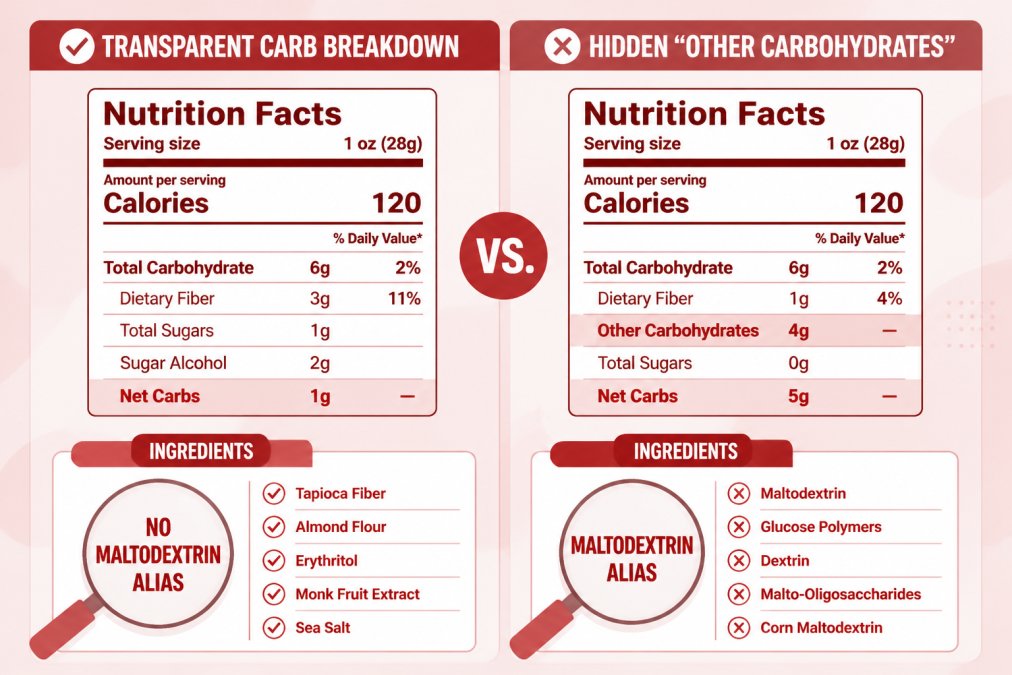
Step 7: Trust only fully transparent brands.
Brands committed to keto list every ingredient clearly and break down carbohydrates completely. Avoid brands using "proprietary blend," "natural flavors," or ambiguous carb sources.
Keto-Friendly Sweeteners Without Maltodextrin
If you want sweetness without the blood sugar spike, several alternatives work for keto. These sweeteners have minimal impact on glucose and insulin levels.
Erythritol, A sugar alcohol with nearly zero net carbs and minimal blood sugar impact. About 70% as sweet as sugar with a slight cooling effect.
Monk fruit, Extracted from luo han guo fruit, monk fruit sweetener has zero carbs and zero calories. It's 150-200 times sweeter than sugar, so manufacturers use small amounts. No blood sugar impact.
Stevia, A plant-based sweetener with zero carbs. Some people report a bitter aftertaste. It's effective but not universally loved.
Allulose, A rare sugar that tastes and behaves like sugar but has minimal carbohydrate impact. It's more expensive and less common but increasingly available.
What these have in common: they don't spike glucose or insulin. They maintain ketosis. Maltodextrin does none of these things.
Clean Keto Snack Alternatives You Can Trust
The safest approach is choosing whole foods and minimally processed snacks.
Store-bought whole-food snacks with zero processing risk:
- Whole nuts and seeds, Almonds, macadamia nuts, pecans, walnuts, and pumpkin seeds are naturally keto-friendly. No processing. No hidden carbs. Portion control matters because nuts contain carbs (roughly 5-7g net carbs per ounce), but they're whole-food carbs with fiber that digests slowly.
- Full-fat cheese, Cheddar, mozzarella, gouda, and hard cheeses have minimal carbs (under 1g per ounce) and high fat content. String cheese and cheese crisps are portable options.
- Olives, High in fat, low in net carbs (roughly 1g net carb per ounce). A simple, whole-food snack that requires no label reading.
- Avocado, High in fat, minimal net carbs (roughly 1g net carb per ounce), naturally satisfying. Eat plain or with salt.
- Hard-boiled eggs, Portable, complete protein, zero carbs. Prepare a batch for the week.
- Beef jerky and meat sticks, Choose brands listing only meat, salt, and spices. Avoid any product with "modified food starch," "corn syrup solids," or "binders" in the ingredient list.
DIY keto snack recipes that eliminate maltodextrin entirely:
Homemade Beef Jerky (No Maltodextrin, No Fillers)
Instead of buying jerky with hidden binders, make your own:
- 2 pounds grass-fed beef (sirloin or flank steak, sliced thin against the grain)
- 2 tablespoons sea salt
- 1 tablespoon black pepper
- 1 tablespoon garlic powder
- Optional: 1 tablespoon smoked paprika for flavor
No-Bake Keto Fat Bombs (Satisfies Sweet Cravings Without Sweeteners)
These require no baking and no thickeners:
- 1 cup natural almond butter (or peanut butter)
- ½ cup coconut oil
- ¼ cup unsweetened cocoa powder
- 2 tablespoons monk fruit sweetener or erythritol (optional)
- Pinch of sea salt
Cheese Crisps (Crunchy, Savory, Zero Carbs)
These are essentially dehydrated cheese:
- 2 cups shredded cheddar or parmesan cheese
- Optional: ½ teaspoon garlic powder, black pepper, or Italian seasoning
The emerging concern: maltodextrin and gut health.
Maltodextrin is a rapidly fermentable carbohydrate that feeds certain bacteria in your gut, particularly pathogenic strains like Proteobacteria and Firmicutes that thrive on processed starches. When you consume maltodextrin, these bacteria proliferate and produce metabolic byproducts (short-chain fatty acids and gases) that can trigger inflammation, bloating, and dysbiosis, an imbalance in your gut bacterial community.
Frequently Asked Questions
Can maltodextrin take you out of ketosis?
Yes. Maltodextrin is a high-glycemic carbohydrate that rapidly raises blood glucose and insulin levels, disrupting ketosis. Even small amounts (5-10 grams) can spike blood sugar enough to halt fat burning. This is why avoiding maltodextrin in keto snacks is critical, one seemingly innocent snack can undo hours of fasting or strict carb control.
What are the best keto-friendly sweeteners without maltodextrin?
Stevia, erythritol, and monk fruit are zero-carb sweeteners that don't trigger insulin spikes. Erythritol has minimal glycemic impact and mixes well in snacks. Monk fruit provides sweetness without aftertaste for many users. Always check labels, some 'keto' products combine these with maltodextrin or other fillers. Read the full ingredient list, not just the sweetener claim.
How do I identify maltodextrin on a nutrition label?
Maltodextrin appears directly in the ingredient list, usually near the top if it's a primary ingredient. Check the total carbohydrates and subtract fiber, if carbs don't match the sweetener amount, hidden maltodextrin or similar starches are likely present. Look for synonyms like 'modified food starch,' 'dextrose,' or 'corn syrup solids.' When in doubt, contact the manufacturer for clarification on ingredient sourcing.
Why do keto snack manufacturers use maltodextrin if it breaks ketosis?
Maltodextrin is cheap, extends shelf life, improves texture, and masks the aftertaste of artificial sweeteners. Manufacturers use it to cut costs and create a more familiar snack texture, not because it fits keto goals. This is why reading labels and choosing brands that prioritize clean ingredients over profit margins matters. Carnivore Solutions uses simple, whole ingredients instead of these fillers.