How to Identify Hidden Fillers in Snacks
Table of Contents
- Why Snack Makers Add Fillers You Never Asked For
- How to Read Nutrition Labels for Hidden Ingredients
- Common Food Additives to Avoid on Any Ingredient List
- The Many Disguises of Added Sugars and Artificial Sweeteners
- Why Artificial Sweeteners Cause Bloating and Gut Stress
- Red Flags in Ingredient Lists on Clean-Label Snacks
- How to Identify Hidden Fillers in Snacks at the Store
- Conclusion: Shop the Ingredient List, Not the Claims
- Frequently Asked Questions
Last Updated: September 5, 2026
The snack aisle is a minefield of misleading marketing, but the real story is always on the back of the package. Hidden fillers are inexpensive ingredients added to boost volume, improve texture, or extend shelf life, often at the expense of nutrition. Learning how to identify them is essential for anyone committed to a clean, low-carb, or carnivore lifestyle. At Carnivore Solutions Inc, we focus on what actually matters: real ingredients and transparent labeling.
Most shoppers check calories or fat first, but that approach misses the bigger picture. The ingredient list and nutrition facts panel reveal the cheap carbohydrates, starches, and chemical compounds manufacturers use to pad their products. Below, we'll show you how to decode these labels, spot red flags, and make smarter choices.
Why Snack Makers Add Fillers You Never Asked For
Fillers exist for one primary reason: profit. By substituting expensive whole ingredients with cheaper alternatives like corn starch, maltodextrin, or cellulose, manufacturers can lower production costs while maintaining a similar appearance and mouthfeel. Fillers are often bulking agents that make a product look larger than it actually is, tricking you into paying more for less nutritional value.
For those on strict ketogenic or carnivore diets, these hidden ingredients are particularly dangerous. Even small amounts of carbohydrate-based fillers can disrupt ketosis, spike blood sugar, and trigger cravings. The regulatory framework around food labeling in the United States, overseen by the Food and Drug Administration (FDA), requires ingredients to be listed in descending order of weight, but it does not require manufacturers to highlight which components are functional fillers versus whole foods. That burden falls on you, the consumer.
How to Read Nutrition Labels for Hidden Ingredients
Most label-reading advice stops at "check the ingredient list." That is not enough. Hidden fillers hide in plain sight within the Nutrition Facts panel itself. Read the label the way a food scientist does, as a series of clues that reveal the product's true composition.
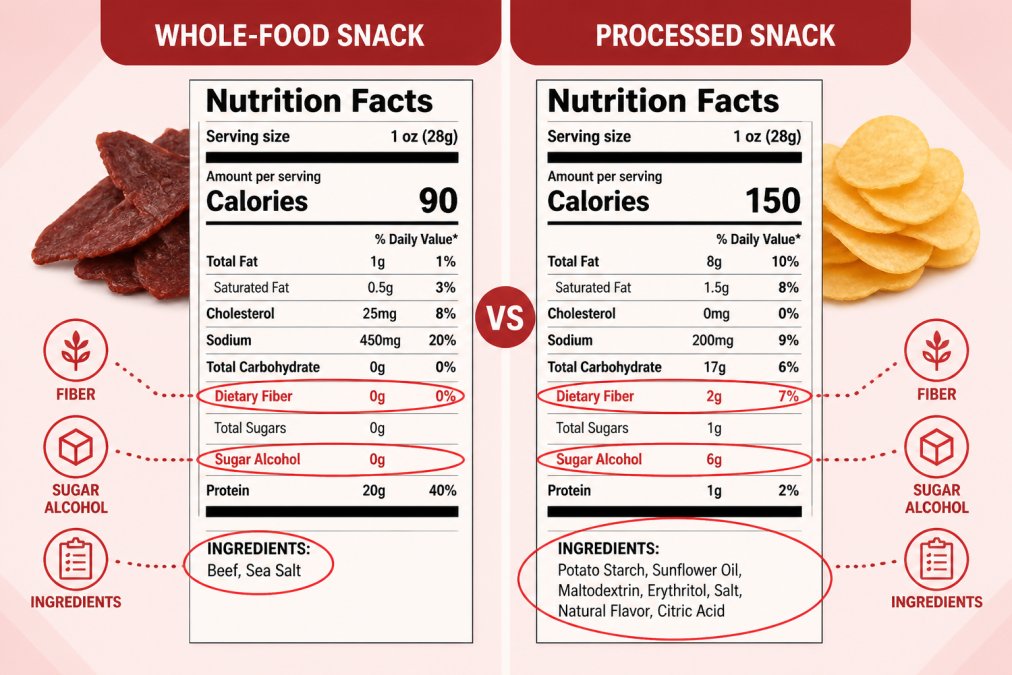
The Fiber Math That Exposes Fillers
When a snack claims to be high in fiber but the ingredient list shows no whole grains, nuts, seeds, or vegetables, the fiber is almost certainly an isolated additive. Look for these specific names:
- Inulin or chicory root fiber, extracted from chicory root, this is the most common "fiber filler" in protein bars and low-carb snacks. It adds bulk and a fiber count without contributing whole-food nutrition.
- Maltodextrin, a white powder made from corn, rice, or potato starch. It is technically a carbohydrate, not a fiber, but it is often paired with isolated fibers to create a "net carb" illusion.
- Cellulose or cellulose gel, powdered wood pulp or plant fiber that adds zero nutrition but inflates fiber numbers and improves texture.
- Polydextrose, a synthetic polymer of glucose, sorbitol, and citric acid used as a bulking agent. It counts as fiber on labels but is not a whole food.
The quick check: If fiber per serving is 3 grams or more, scan the ingredient list. If no recognizable whole-food fiber source appears within the first five ingredients, the fiber is likely an additive.
The Sugar Alcohol Subtraction Trap
Sugar alcohols (erythritol, xylitol, sorbitol, maltitol) are listed under total carbohydrates but are not fully digested. Many low-carb snack makers subtract them entirely from their "net carb" calculation on the front of the package. That math is not always honest.
Maltitol has a glycemic index of about 35, roughly two-thirds that of table sugar, and will raise blood glucose despite being marketed as sugar-free. Erythritol has a glycemic index of zero and is generally well-tolerated, but can cause digestive distress above 15-20 grams per day.
The quick check: Look at the sugar alcohol line on the label. If it lists maltitol or sorbitol, treat the product as having a real carbohydrate impact. If it lists erythritol or monk fruit, the net carb claim is more credible.
The Serving Size Shell Game
Serving sizes are set by the manufacturer, not the FDA, and are often unrealistically small. A protein bar listing "1 bar" is honest; a trail mix listing "1/4 cup" when most people eat a full cup is not.
The FDA requires serving sizes to reflect actual consumption, but manufacturers can still use the "per container" line to obscure the math. If a bag contains 2.5 servings and you eat the whole bag, multiply every number by 2.5, including filler-derived carbohydrates.
A Visual Label-Decoding Checklist
Use this checklist in the aisle. It takes 30 seconds and catches most hidden fillers:
- Check the fiber line. If fiber is high (3g+), confirm the source is a whole food.
- Check the sugar alcohol line. If maltitol or sorbitol appears, assume a real blood sugar impact.
- Check the ingredient list for isolated starches. Look for corn starch, tapioca starch, potato starch, or modified food starch. If any appears before a protein or whole-food ingredient, the product is filler-heavy.
- Check the serving size vs. what you will actually eat. If the serving is smaller than your typical portion, multiply the carbohydrate numbers.
- Check the "other carbohydrate" line. This line on the label captures starches and fibers not classified as sugars. If it is high and the ingredient list shows no whole-food source, fillers are present.
This checklist-based approach turns label reading from a vague exercise into a repeatable system. The goal is not to memorize every additive, it is to recognize the structural patterns that reveal when a manufacturer is padding a product with cheap bulk.
Common Food Additives to Avoid on Any Ingredient List
Certain additives appear so frequently in processed snacks that they should trigger immediate suspicion: modified food starch, maltodextrin, cellulose gel, and various gums. Though many derive from corn or wheat, they are so highly processed they function more like chemical additives than whole foods.
The challenge is that these common food additives to avoid are often buried deep in the ingredient list under unfamiliar names. Understanding the ingredient hierarchy helps: because ingredients are listed by weight, if a filler appears before a protein source, the product contains more filler than actual food. The USDA FoodData Central guidance provides a searchable database of ingredients, but in practice, you need a memorized list of red flags to shop efficiently.
Synthetic Dyes, Emulsifiers, and Stabilizers
Synthetic dyes like Red 40, Yellow 5, and Blue 1 offer zero nutritional benefit. Emulsifiers such as soy lecithin and mono- and diglycerides blend ingredients that would otherwise separate, while stabilizers like carrageenan and xanthan gum alter texture. None improve the nutritional profile, and some research suggests they may negatively impact gut health.
For a clean-label snack, the ingredient list should be short and recognizable. A string of chemical-sounding names signals the product relies on additives to mimic a higher-quality item. When in doubt, put it back on the shelf.
The Many Disguises of Added Sugars and Artificial Sweeteners
Added sugars are the most deceptive category of hidden fillers because they go by dozens of names. The nutrition facts label includes an "added sugars" line, but it only captures the total, not the variety used. Manufacturers often blend three or four sweeteners so no single one appears high on the ingredient list, obscuring the true sugar load.
Spotting these requires familiarity with the suffix "-ose," which usually indicates a sugar. Glucose, sucrose, dextrose, maltose, and fructose are all sugars, regardless of how natural they sound. Syrups like brown rice syrup, corn syrup, and agave nectar are concentrated sugar sources that spike blood glucose as fast as table sugar.
Spotting Dextrose, Maltose, and Agave Nectar
Dextrose and maltose are simple sugars derived from corn and grains, frequently used as cheap sweeteners and fillers in processed meats and snacks. Agave nectar is often marketed as low-glycemic, but it is exceptionally high in fructose, which the liver can metabolize into fat and triglycerides. These ingredients have no place in a snack marketed as clean or keto-friendly.
The presence of these sugars in savory snacks like jerky or protein bars is a major red flag, indicating the manufacturer is masking the flavor of lower-quality ingredients. Check the added sugars line and the ingredient list for these hidden sweeteners before purchasing.
Why Artificial Sweeteners Cause Bloating and Gut Stress
Artificial sweeteners are often used to replace sugar in low-carb products, but they bring their own problems. Sugar alcohols like sorbitol, mannitol, and xylitol are poorly absorbed, drawing water into the gut and fermenting in the colon, leading to gas, cramping, and bloating. Even small amounts can cause significant discomfort for sensitive individuals.
Non-nutritive sweeteners like sucralose and aspartame have been shown to alter the gut microbiome in animal studies, with downstream effects on metabolic health and inflammation. Products designed to be "diet-friendly" often trigger the very gastrointestinal issues that drive people to seek cleaner options. For those on a carnivore diet, the solution is simple: avoid sweeteners entirely.
Red Flags in Ingredient Lists on Clean-Label Snacks
Even products that scream "clean label" can contain hidden ingredients. "Natural flavors" is an umbrella term that can include chemical solvents and preservatives used in flavor extraction. Similarly, "spices" can hide anti-caking agents like silicon dioxide.
Another red flag is the presence of "modified" ingredients, such as modified corn starch or modified cellulose. The modification process improves function as a thickener or stabilizer but renders the ingredient highly processed. A genuinely clean-label snack should have an ingredient list a nutritionist would recognize without a dictionary.
How to Identify Hidden Fillers in Snacks at the Store
The practical application happens in the grocery aisle, where you must make quick decisions under time pressure. Flip the package over and read the ingredient list before looking at the front of the bag. If the list is longer than two lines or contains more than five ingredients, it is likely highly processed.
A useful rule of thumb is to consider the ingredient list as a recipe. Would you be able to make this snack at home with the ingredients listed? If the answer is no, or if you would need to buy specialized chemical additives, the product is probably full of fillers. The Dietary Guidelines for Americans recommend limiting added sugars and saturated fats, but they also emphasize the importance of choosing foods with minimal processing, which is the core principle of label reading.
Use a Scanner App Before You Buy
Scanner apps that analyze ingredient lists can be valuable when you are in a hurry. They use a database of food additives and flag those linked to health concerns or common allergens. They are not perfect, but they serve as a useful first line of defense against hidden fillers.
Decode the Marketing Tricks on the Front of the Bag
Front-of-package claims like "low carb," "sugar-free," or "keto-friendly" are marketing tactics, not regulatory certifications. The FDA has strict rules for nutrient content claims like "low sodium" or "high fiber," but terms like "natural" and "clean" are not well-defined. The FTC truth in advertising standards require claims to be truthful and not misleading, but they do not prevent manufacturers from using vague, positive-sounding language to create a health halo around a heavily processed product.
Bright colors, rustic imagery, and words like "artisan" or "small batch" trigger an emotional response that overrides rational analysis. The only reliable defense is to ignore the front of the package and judge the product solely on its ingredient list.
| Label Claim | What It Really Means | What to Check |
|---|---|---|
| "Keto-Friendly" | No official definition | Net carbs per serving |
| "Natural" | Minimal regulation | Full ingredient list |
| "Sugar-Free" | No added sugars | Sugar alcohols & sweeteners |
| "High Protein" | 20% DV per serving | Protein-to-carb ratio |
Conclusion: Shop the Ingredient List, Not the Claims
The most important habit is to treat the front of any packaged snack with skepticism and the back with scrutiny. Hidden fillers are pervasive, but not invisible once you know what to look for. By mastering the nutrition facts label, memorizing common names for added sugars and additives, and understanding why artificial sweeteners cause bloating, you can navigate the store with confidence.
This is the philosophy we apply to every product we make at Carnivore Solutions Inc. Our 100% grass-fed beef jerky and sugar-free electrolyte powders are crafted with zero fillers, zero sugar, and no artificial sweeteners, so you never have to decode a mystery ingredient. Get started with Carnivore Solutions Inc and fuel your body with nothing but real, transparent ingredients.
Frequently Asked Questions
What are the most common hidden fillers found in processed snacks?
The most common hidden fillers are maltodextrin, dextrose, modified food starch, and cellulose. Manufacturers use them to add bulk, improve texture, or extend shelf life cheaply. These fillers often spike total carbohydrates without adding protein or fat, which is a problem if you follow a low-carb or carnivore diet. Check the ingredient list for anything ending in -ose or -dextrin, and watch for starches that appear even when the label claims zero sugar.
How can I tell if a snack labeled 'clean' actually contains artificial sweeteners?
Look for terms like sucralose, aspartame, acesulfame potassium, and sugar alcohols such as sorbitol or maltitol. These common food additives to avoid can hide under brand names like Splenda or Equal, so scan the full ingredient list rather than trusting the front label. Artificial sweeteners are often added to 'zero sugar' snacks, and they can cause bloating and digestive discomfort. If you see these names, the product is not as clean as the packaging suggests.
Why do manufacturers add fillers and additives to snacks in the first place?
Fillers and additives cut production costs and improve texture, shelf life, or mouthfeel. For example, maltodextrin adds volume cheaply, while emulsifiers keep ingredients from separating. The trade-off is metabolic health: many of these additives spike blood sugar or disrupt digestion. Understanding this incentive helps you read nutrition labels for hidden ingredients with more skepticism. If a snack lists more than five ingredients and you cannot pronounce several, it likely contains fillers you do not need.
Does 'no added sugar' on a package mean the snack is filler-free?
No. 'No added sugar' only means the manufacturer did not add sugar, but the product can still contain sugar alcohols, artificial sweeteners, or refined starches like maltodextrin that act like sugar in the body. These ingredients often appear in the ingredient list as dextrose or maltose. To identify hidden fillers in snacks, check the total carbohydrates on the nutrition facts label and scan for starches and sweeteners, not just the word 'sugar'.