How to Verify Grass Fed Beef: A 2026 Guide
Table of Contents
- Start With the Label: Decoding USDA Grass-Fed Certification Requirements
- Grass-Fed vs Grass-Finished Beef: Why the Difference Matters
- Visual Indicators of Real Grass-Fed Beef
- Third-Party Beef Certifications That Add Real Proof
- How to Buy Grass-Fed Beef Jerky Online Without Getting Fooled
- Ask the Right Questions at a Butcher Shop or Farm
- Conclusion
- Frequently Asked Questions
Last Updated: September 11, 2026
Start With the Label: Decoding USDA Grass-Fed Certification Requirements
Learning how to verify grass fed beef starts with the label, because "grass fed beef" is one of the most loosely policed claims in the meat case. The USDA's Food Safety and Inspection Service (FSIS) does not run its own grass-fed certification program; instead, it requires that label claims be truthful and not misleading, and it reviews the supporting documentation a producer submits before a claim can appear on packaging (fsis.usda.gov). That distinction matters more than most shoppers realize.
Here's the uncomfortable part: the word "grass-fed" on a package is a claim, not a certificate. Unless a third-party verifier or a documented audit trail stands behind it, you are trusting the producer's own paperwork.
This guide breaks down the label language, the certifications worth trusting, and the visual and conversational checks that separate real grass-fed beef from clever marketing.
What the USDA Grass-Fed Label Actually Means
The USDA grass-fed label means the animal ate a forage-based diet, typically grass, for its entire life after weaning, with no grain in the finishing phase (ams.usda.gov). Producers must document that diet, and FSIS reviews the claim before approving the label. What FSIS does not do is send an inspector to every farm to watch the herd eat.
Labels That Don't Carry Legal Weight
"Grass-fed style," "pasture-influenced," and "naturally raised" are marketing language, not regulated diet claims. None of them require the animal to have eaten grass for its whole life. If a package leans on those words instead of a named certification, treat the claim as unverified until you see supporting documentation.
Grass-Fed vs Grass-Finished Beef: Why the Difference Matters
The difference between grass-fed and grass-finished beef is timing. "Grass-fed" can describe an animal that ate grass for part of its life and then moved to a grain finishing ration. "Grass-finished" means the animal stayed on forage through slaughter, never receiving grain at the end.
That final phase is where flavor, fat color, and nutrient profile are largely set. A grain-finished animal lays down the white, heavily marbled fat most steakhouse menus celebrate. A grass-finished animal carries less marbling and fat with a more yellow cast, which is why the two products look and cook differently.
A common approach among ranchers is to use "grass-fed, grain-finished" honestly, and there is nothing wrong with that beef. The problem is when a package says "grass-fed" and lets you assume "grass-finished." Ask which one you are buying.
Visual Indicators of Real Grass-Fed Beef
Real grass-fed beef usually shows two visible signs: fat with a yellow tint and less intramuscular marbling than grain-finished beef. Neither sign is proof on its own, but together they are a useful first filter.
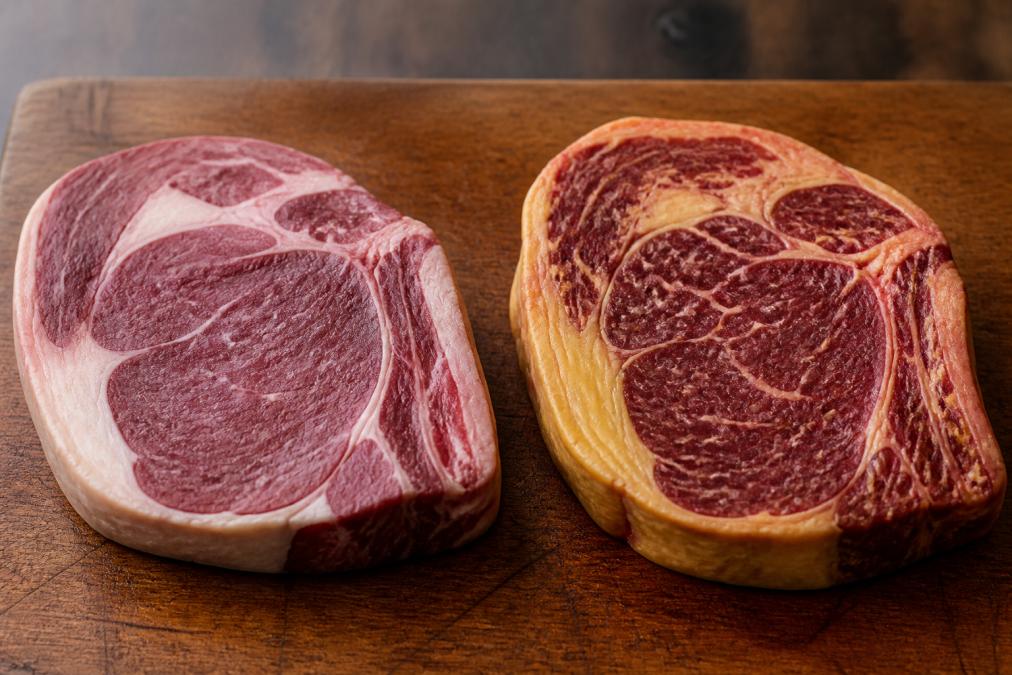
Fat Color and Marbling
The yellow color comes from carotenoids, plant pigments the animal absorbs from forage (PubMed). A grass-finished animal eating fresh pasture accumulates more of them, so the fat cap and the thin streaks of marbling carry a golden tone. Grain-finished beef tends to show white fat because the finishing diet dilutes those pigments.
What most guides miss is that fat color shifts with the season. An animal finished on lush spring pasture can show stronger yellow than one finished on dormant winter range, even on the same farm. Fat color is a clue, not a verdict.
Meat Color and Texture
Grass-finished beef often looks a deeper, darker red than grain-finished beef, and the muscle fibers read as slightly coarser. Leaner meat also cooks faster, so a grass-fed steak that hits the same internal temperature as a grain-fed one can taste dry. Pull it off the heat earlier and rest it longer.
Third-Party Beef Certifications That Add Real Proof
Third-party beef certifications add real proof because an independent auditor, not the producer, verifies the diet and handling claims on a recurring schedule. But before you can rank certifications, you need to understand what the government actually regulates versus what is voluntary marketing, because that line is where most shoppers get fooled.
What the USDA Actually Regulates vs. What Is Voluntary
The USDA's Food Safety and Inspection Service (FSIS) does not operate its own grass-fed certification program. What FSIS does is review label claims for truthfulness under the Federal Meat Inspection Act and its labeling regulations. A producer who wants to print "grass-fed" on a package must submit documentation supporting that claim, and FSIS evaluates whether the claim is truthful and not misleading before approving the label.
That is the entire federal mechanism: a paperwork review, not a farm audit. FSIS does not send inspectors to watch a herd eat. So the "USDA" stamp you see on a package most often refers to the facility passing federal inspection standards, a food-safety checkpoint, not a diet verification.
Here is the practical split:
- Federally regulated: food safety inspection, ingredient statements, net weight, country-of-origin labeling for covered products, and the truthfulness of any diet claim that appears on the label.
- Voluntary / producer-asserted: the actual on-farm diet, pasture access, and finishing phase, unless a named third-party certifier audits them.
The Certification Programs Worth Knowing
When you want proof beyond the producer's own paperwork, look for a named certifier. The most recognized programs in the U.S. market include:
- American Grassfed Association (AGA) Certified Grassfed. Requires a 100% forage diet from weaning to harvest, continuous pasture access, no confinement, no antibiotics, and no added hormones. Audited annually by an independent third party.
- Certified Grassfed by A Greener World (AGW). Similar forage-and-pasture standards, with a published certification manual and on-site audits.
- Animal Welfare Approved (also AGW). Focuses on pasture-based management and animal welfare; the diet standards overlap with grass-fed expectations.
- USDA Process Verified Program (PVP). A voluntary USDA audit service where a company pays for USDA to verify specific claims, including grass-fed, through an approved audit protocol. This is the closest thing to a federal grass-fed verification, but it is opt-in and paid for by the producer, not universal.
Each of these programs audits feed, pasture access, and animal handling on a recurring schedule, typically annually, and each publishes its standards, which is what separates them from a self-declared label.
A Practical Trust Hierarchy for the Meat Case
| Verification level | What it proves | How much to trust it |
|---|---|---|
| No claim, no certification | Nothing about diet | Unverified |
| Producer's own "grass-fed" claim | The producer says so | Low |
| USDA-reviewed label claim | Documented forage diet, paperwork review only | Moderate |
| Named third-party certification (AGA, AGW) | Independent annual audit trail | High |
| USDA Process Verified Program | USDA-audited protocol for the specific claim | High |
| Certification plus farm visit | Diet, welfare, traceability, your own eyes | Highest |
Buying direct-to-consumer from a ranch that welcomes visitors sits at the top of that table. You are not relying on paperwork; you are relying on your own eyes. And when a package carries a named certification, you can look that certifier up and read its published standards, which is something you can never do with a bare "grass-fed" claim.
How to Buy Grass-Fed Beef Jerky Online Without Getting Fooled
Buying grass-fed beef jerky online is where verification gets hardest, because you cannot see the fat color or smell the product before it ships. The fix is to read the product page like an auditor: look for a named certification, a stated country of origin, and an ingredient list short enough to fit on a sticky note.
What to Look for on a Product Page
- A specific certification name, not just the words "grass-fed"
- A clear statement that the beef is grass-finished, not merely grass-fed
- Country of origin, ideally domestic
- An ingredient list without fillers, added sugars, or artificial additives
- A traceability statement naming the ranch or region
Carnivore Solutions Inc offers 100% grass-fed beef jerky with zero sugar and zero fillers, using domestically sourced beef. If a product page cannot answer the five questions above, that silence is your answer.
Ask the Right Questions at a Butcher Shop or Farm
A butcher shop or farm visit gives you the one thing no label can: a person who has to look you in the eye and answer. Come prepared with specific questions, and listen as much for hesitation as for the answer.
The Questions That Separate Real Operations From Resellers
- "Is this grass-fed or grass-finished?" A confident answer distinguishes the two. A vague one blurs them, and blurring is usually intentional.
- "Which certification does the ranch carry, and can I see the certificate?" Named programs (AGA, AGW, USDA PVP) have documentation. Real operations are used to this question and can produce it.
- "Where was the animal raised and finished?" Traceability matters. Direct-to-consumer ranches usually volunteer the region or even the specific pasture without prompting.
- "What was the animal eating in its last 90 days?" This is the finishing-phase question that reveals whether "grass-fed" quietly became "grain-finished."
- "Do you ever run out and source from elsewhere?" Honest butchers will tell you when supply gaps force them to bring in outside product, and whether that product meets the same standard.
A butcher who can answer all five without reaching for a binder is a good sign. A butcher who deflects to "it's all natural" is telling you something too.
The Budget-Friendly Verification Route
Verifying grass-fed beef does not require paying boutique prices at a specialty grocer. The cheapest verification is often the most direct: buy from the producer.
- Buy a quarter or half share direct from a ranch. Buying in bulk directly from a producer typically costs less per pound than buying individual cuts at retail, and you get to visit the farm, see the pasture rotation, and ask your questions in person. Many ranches list share pricing and pickup dates on their websites.
- Check farmers markets in season. Vendors at a farmers market are physically present and accountable. Ask the same five questions; most will answer on the spot.
- Look for ranch tours and on-farm pickup days. Many local food systems now run these. A Saturday drive to a farm costs less than a premium markup at a specialty grocer, and you see the forage-based diet for yourself.
- Split a share with a friend or neighbor. A quarter share is a lot of beef for one household. Splitting it cuts your upfront cost and your freezer space requirement in half.
- Watch for end-of-season and freezer-clearance pricing. Ranches often discount remaining inventory before the next harvest. The beef is the same; the price is not.
What to Do When You Cannot Visit
If a farm visit is not realistic, the next best thing is a producer who publishes its certification, its ranch location, and its harvest practices online, and who answers email or phone questions directly. A producer willing to put a name and a place behind the claim is doing more verification work for you than any package ever will.
Conclusion
The real challenge in verifying grass-fed beef is that the label asks for your trust while offering you very little proof. Fat color, marbling, certification names, and a rancher's straight answer are the tools that close that gap. Carnivore Solutions Inc offers 100% grass-fed beef jerky with zero sugar and zero fillers, plus sugar-free electrolyte powders with five key electrolytes and no artificial sweeteners, all made domestically.
Start with the certification, confirm the finish, and buy from producers who answer questions without flinching. Shop Carnivore Solutions Inc for beef jerky and electrolytes.
Frequently Asked Questions
How can I tell if beef is actually grass-fed?
Check the label for a USDA Grass Fed certification or a recognized third-party seal like the American Grassfed Association. Look for yellowish fat, which comes from carotenoids in a forage-based diet. Ask the farmer or butcher directly about the animal's diet, whether it was pasture-raised year-round, and whether the farm uses pasture rotation. No single visual cue is foolproof, so combine label checks with sourcing questions.
What does the USDA grass-fed label actually mean?
The USDA Grass Fed claim requires that the animal ate only grass and forage after weaning, with no grain. The animal must have continuous access to pasture during the growing season. However, the USDA does not conduct on-farm inspections for this claim. Instead, it relies on the producer's own documentation and a signed affidavit. This is why third-party certification adds a stronger layer of proof for buyers.
What are the most reliable third-party certifications for grass-fed beef?
The American Grassfed Association (AGA) certification requires 100% grass and forage diet, year-round pasture access, and no antibiotics or hormones. Certified Grassfed by A Greener World (AGW) also verifies a forage-based diet and high animal welfare standards. Both programs conduct regular on-site farm inspections, which go beyond the USDA's self-reported process. Look for these seals on packaging when you buy grass-fed beef jerky online.
What does real grass-fed beef look like in terms of fat color?
Grass-fed beef typically has yellowish fat because the animal's forage-based diet contains carotenoids from fresh grass. Grain-fed beef tends to have white or cream-colored fat. The color can shift with the season: cattle on spring and summer pasture often show more yellow, while winter forage or stored hay may produce a paler fat cap. Fat color alone is not definitive, but it is a useful visual clue alongside certifications.