7 Erythritol Digestive Health Facts You Need to Know
Last Updated: October 24, 2026
Quick Summary
Erythritol digestive tolerance is high because roughly 90% is absorbed in the small intestine and excreted unchanged, leaving little to ferment in the colon. In human studies, single doses of 20 g and 35 g did not significantly increase gastrointestinal symptoms, unlike xylitol.
- Roughly 90% of ingested erythritol is absorbed before it reaches the colon.
- Erythritol is better tolerated than sorbitol and xylitol at comparable doses.
- Reviews report erythritol does not appear to shift gut microbiota composition.
- A pint of keto ice cream can carry 15-20 g of erythritol in the whole container.
- Start with one serving of one product and add a second only after a symptom-free day.
Table of Contents
- What Erythritol Is and How Your Body Handles It
- Side Effects of Sugar Alcohols: What Applies to Erythritol and What Doesn't
- Does Erythritol Disrupt the Gut Microbiome?
- Bloating From Artificial Sweeteners: Why Erythritol Stands Apart
- The Erythritol Digestive Tolerance Threshold: Dose Data From Human Studies
- Who May Be More Sensitive and When to See a Doctor
- Reading Labels and Choosing Sugar-Free Products That Sit Well
- Choosing Electrolytes Without Digestive Guesswork
- Frequently Asked Questions
What Erythritol Is and How Your Body Handles It
Erythritol is a four-carbon sugar alcohol used as a zero-calorie sweetener, and it behaves very differently from the sugar alcohols that give "sugar-free" a bad name. At Carnivore Solutions Inc, we field constant questions from low-carb customers about whether sweeteners will wreck their stomachs, so we went through the clinical literature on erythritol digestive effects. The short answer: most of the compound is absorbed in the small intestine and excreted unchanged in urine, which leaves very little behind to ferment. That single fact explains most of what follows.
Absorption in the Small Intestine
Roughly 90% of ingested erythritol is absorbed before it reaches the colon, and the remainder passes through largely intact. Because so little reaches the lower gut, there is minimal substrate for bacterial fermentation, the process that produces gas and bloating with other polyols. Compare that to sorbitol or maltitol, which arrive in the colon mostly unabsorbed.
Side Effects of Sugar Alcohols: What Applies to Erythritol and What Doesn't
Most erythritol side effects are mild and dose-dependent, and the severe laxative reputation attached to sugar alcohols does not transfer cleanly. A review in Nutrients on sugar alcohol tolerance notes that excessive sugar-alcohol intake is associated with nausea and abdominal bloating, but that finding covers the whole class, not erythritol specifically. The same review reports erythritol is better tolerated, with fewer gastrointestinal side effects than sorbitol and xylitol at comparable doses.
That distinction matters. Generalizations about sugar alcohols are where most articles go wrong.
Does Erythritol Disrupt the Gut Microbiome?
This is where the evidence gets the most misread, so it helps to separate what each type of study can actually establish. Human tolerance trials, laboratory culture work, and animal studies answer different questions, and headlines routinely blend them.
What human studies show. Controlled human dosing trials focus on symptoms, not on sequencing the gut flora. In the tolerance work indexed on PubMed, the measured outcomes were gastrointestinal symptoms and stool characteristics, not bacterial composition. That is an important limit: a trial showing few symptoms at 35 g does not, by itself, prove the microbiome is unchanged. It shows the dose was tolerated by the people tested.
What laboratory and animal research shows. In vitro fermentation studies and animal models have reported that erythritol is poorly fermented by colonic bacteria compared with sorbitol, maltitol, and other polyols, which is consistent with its near-complete small-intestine absorption. Some laboratory work has also reported effects on bacterial growth at high concentrations. These findings are useful for generating hypotheses, but they use concentrations and conditions that do not map cleanly onto a person eating a few grams of sweetener in a beverage.
What the reviews conclude. A review in Advances in Nutrition on sweeteners and gut microbiota reports that erythritol, sorbitol, and mannitol do not appear to shift gut microbiota composition, while lactitol, isomalt, xylitol, and maltitol do provoke shifts. Read that carefully: the comparison is between polyols, and the underlying data are largely short-term.
The long-term gap. Sustained intake over months and years is understudied in humans. Short-term bacterial-growth findings from a lab dish are not the same as demonstrated changes in human gut health, and no one has run the multi-year human trials that would settle the question. Anyone claiming erythritol is proven harmless, or proven harmful, to gut bacteria over decades is overreaching in one direction or the other.
Bloating From Artificial Sweeteners: Why Erythritol Stands Apart
Bloating from artificial sweeteners usually traces to fermentation or an osmotic effect in the colon, and erythritol triggers both far less than its cousins. With minimal substrate reaching the lower gut, there is little for intestinal bacteria to ferment into gas. For readers who want the mechanism in more depth, our breakdown of why artificial sweeteners cause bloating covers the osmotic and fermentative pathways side by side.
The Erythritol Digestive Tolerance Threshold: Dose Data From Human Studies
The erythritol digestive tolerance threshold sits higher than most people assume, based on controlled human dosing. In a tolerance study indexed on PubMed, erythritol doses of 20 g and 35 g did not significantly increase gastrointestinal symptoms, while xylitol produced significantly more watery stools at every tested intake level. That is a striking split: 35 g is a large single dose, and it still failed to move symptom scores in the study population.
| Sweetener | Dose Tested | GI Symptom Result | What It Means |
|---|---|---|---|
| Erythritol | 20 g, 35 g | No significant increase | High tolerance at large single doses |
| Xylitol | All tested levels | More watery stools | Lower threshold, laxative effect |
| Sorbitol | Comparable doses | More GI side effects | Less tolerated than erythritol |
Translate the study dose into a real serving. Thirty-five grams is not a typical food portion. A single-serve sugar-free drink mix or a low-carb protein bar often delivers 2-10 g of erythritol per serving; a pint of keto ice cream can carry 15-20 g in the whole container. The study doses sit at or above the top of that everyday range, which is why most people eating normal portions do not hit the threshold, and why someone eating several "zero-sugar" products across a day can.
Cumulative intake is what catches people. The threshold is not a per-food number; it is a daily total. Three sugar-free beverages at 8 g each plus a protein bar at 10 g is 34 g before dinner. Track the sum across foods and drinks, not the dose in any one item.
Body weight and repeated exposure matter. Tolerance studies dose by grams, not by grams per kilogram, so a smaller person reaches a given gram load with fewer servings. Repeated daily exposure also tends to improve tolerance for sugar alcohols generally, though erythritol's high absorption means there is less colonic adaptation to develop in the first place.
What the study can and cannot tell you. It establishes that a large single dose was well tolerated by the study participants under controlled conditions. It does not establish a universal threshold, does not test every population (people with irritable bowel syndrome, for example, are often excluded from such trials), and does not capture cumulative daily intake. Treat 20-35 g as a generous ceiling observed in research, not a personal target.
Who May Be More Sensitive and When to See a Doctor
Individual sensitivity varies, and some people report gas or loose stools at doses well below study thresholds. If you have irritable bowel syndrome or a history of gastrointestinal intolerance, start with small servings and track symptoms against your daily intake. Watch out: persistent diarrhea, severe stomach pain, or symptoms that outlast the exposure by more than a day are reasons to stop and speak with a clinician, not to push through.
Reading Labels and Choosing Sugar-Free Products That Sit Well
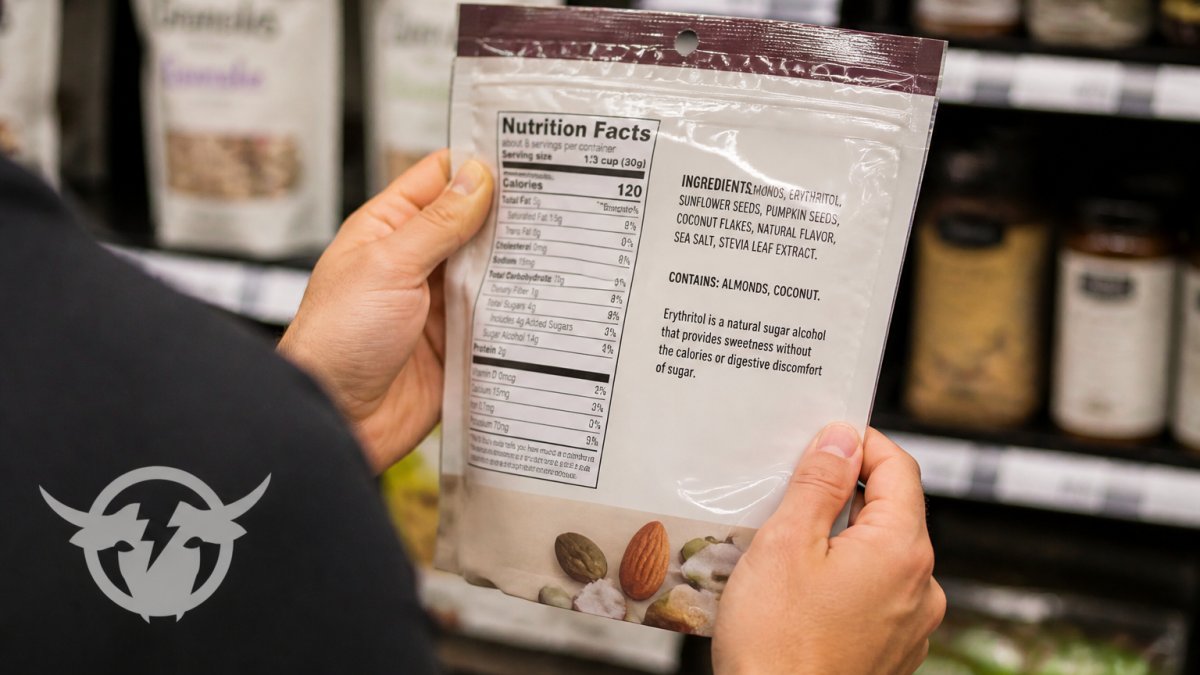
Label literacy is the practical skill that separates a smooth experience from an upset stomach, because serving size hides the real dose. A product listing erythritol second or third in the ingredients may deliver 10 g or more per serving, and eating two servings doubles it. Our guide on how to read nutrition facts labels walks through spotting polyols and checking serving sizes before you commit. Shoppers buying low-carb snacks should also review how to identify hidden sugars in keto snacks, since "keto-friendly" does not guarantee a clean ingredient panel.
Choosing Electrolytes Without Digestive Guesswork
Electrolyte powders are where sweetener choice hits hardest, since you drink them daily and often on an empty stomach during fasting. Our approach at Carnivore Solutions Inc is simple: zero sugar, zero fillers, five key electrolytes, and no artificial sweeteners of any kind, so there is no erythritol dose to calculate and no polyol load to track. Customers tell us that matters. "I like that this doesnt have any artificial sweeteners," one reviewer noted, while another said it is "my go to electrolyte with no crash."
If you want to compare sweetener-free options, browse our electrolyte powder without artificial sweeteners or jump straight to the best sugar free electrolyte powder for your training schedule.
Frequently Asked Questions
Does erythritol cause bloating and gas?
Less often than most sugar alcohols. In a tolerance study, 20 g and 35 g of erythritol did not significantly increase gastrointestinal symptoms, while xylitol produced significantly more watery stools at every tested intake level. A 2023 review in Nutrients also reports erythritol is better tolerated than sorbitol and xylitol at comparable doses. Large amounts of any sugar alcohol can still cause bloating in some people, so start with a small serving and increase gradually.
How much erythritol is safe to consume daily?
There is no single number that fits everyone. The published tolerance study tested 20 g and 35 g in a single sitting without a significant rise in digestive symptoms, which gives a useful reference point for erythritol digestive tolerance. Individual sensitivity varies, so a practical approach is to keep single servings modest, spread intake across the day, and pay attention to how your stomach responds. People with irritable bowel syndrome or a history of digestive issues should be more cautious and discuss intake with a doctor.
Is erythritol easier to digest than other sugar alcohols?
Yes, for most people. Erythritol is absorbed in the small intestine before it reaches the colon in large amounts, which limits the fermentation that causes gas and bloating from artificial sweeteners like sorbitol and maltitol. A 2019 review in Advances in Nutrition reports that erythritol, sorbitol, and mannitol do not affect gut microbiota composition, while lactitol, isomalt, xylitol, and maltitol provoke shifts. Tolerance still depends on dose and individual sensitivity.
Can erythritol cause diarrhea in sensitive individuals?
It can, though it is less likely than with other sugar alcohols. The 2007 tolerance study found xylitol produced significantly more watery stools at all tested levels, while erythritol at 20 g and 35 g did not significantly increase symptoms. A 2023 review notes that excessive sugar-alcohol intake in general is linked to nausea and abdominal bloating. If diarrhea appears after sugar-free products, check total sugar-alcohol load across everything you ate that day, not just one item.
Most people can tolerate erythritol well, but the cleanest solution is skipping the sweetener question entirely. Carnivore Solutions Inc makes sugar-free electrolyte powder with five key electrolytes and no artificial sweeteners, plus 100% grass-fed beef jerky for high-protein snacking between meals. Get started with Carnivore Solutions Inc and fuel your low-carb routine without reading a single ingredient panel twice.