How to Identify Hidden Sugars in Keto Snacks
Table of Contents
- Why Hidden Sugars Matter on Keto
- Hidden Sugar Names on Food Labels You Need to Know
- How to Read Keto Snack Nutrition Labels
- Sugar Alcohols in Keto Snacks: What Actually Counts
- Hidden Sugars in Beef Jerky and Meat Snacks
- Common Label Tricks That Hide Sugar Content
- Your Keto Snack Label-Reading Checklist
- Frequently Asked Questions
Last Updated: October 7, 2026
Why Hidden Sugars Matter on Keto
When you're following a ketogenic diet, every gram of carbohydrate counts. Hidden sugars can derail ketosis without you realizing it, which is why learning how to identify hidden sugars in keto snacks is essential.
Many keto snack brands exploit this confusion. They'll slap "sugar-free" on the front while loading the ingredient list with compounds that behave like sugar in your body. Your blood sugar spikes. Your insulin response kicks in.
At Carnivore Solutions Inc, we've built our entire product line around transparency. No hidden junk. No ingredient names that require a chemistry degree to decode. Just grass-fed beef, bone broth, and sea salt. That's it.

The stakes are real. One seemingly innocent snack bar can contain enough hidden carbohydrates to knock you out of ketosis for hours.
Hidden Sugar Names on Food Labels You Need to Know
Food manufacturers use dozens of ingredient names to disguise sugar. They do this because "sugar" scares consumers away, but a word ending in "-ose" or labeled as a "natural sweetener" feels safer. It doesn't matter what they call it, your body processes it the same way.
Ingredients Ending in -ose
Any ingredient ending in "-ose" is a sugar. Period. This is the easiest rule to remember and it catches most of the sneaky ones.
Common sugar names ending in -ose:
- Maltose
- Dextrose
- Fructose
- Glucose
- Sucrose
- Lactose
These are all sugars. They all raise blood glucose. They all interrupt ketosis. If you see any of these on a keto snack label, put it back on the shelf.
Maltodextrin deserves special attention because it appears on many "keto-friendly" products. It's made from corn, potato, or rice starch and breaks down into glucose rapidly. Your body treats it like pure sugar.
Dextrose is another frequent offender. It's glucose in its simplest form, the fastest way to spike blood sugar. Yet some brands hide it in beef jerky and protein bars marketed to low-carb dieters. Always scan for it.
Syrups and Sweetener Concentrates
Syrups are liquid sugar, and manufacturers use them because they dissolve easily into snack formulations. The names sound innocent. They're not.
Watch for these:
- Brown rice syrup
- Agave nectar
- Maple syrup
- Honey
- Molasses
- Coconut syrup
- Tapioca syrup
Brown rice syrup is particularly common in "health-focused" snacks. It's marketed as natural and wholesome. In reality, it's nearly pure carbohydrate, often worse than regular sugar for blood glucose response.
Agave nectar gets pushed as a low-glycemic option. This is marketing fiction. Agave is extremely high in fructose, which your liver processes differently than glucose but still converts to fat and disrupts metabolic health. It belongs nowhere near a keto snack.
Starch-Based Hidden Sugars
Modified food starch, tapioca starch, and potato starch are carbohydrates masquerading as neutral fillers. They're in the ingredient list to improve texture, but they break down into glucose in your digestive system.
Look for:
- Modified food starch
- Tapioca starch
- Potato starch
- Corn starch
- Arrowroot powder
These aren't labeled as sugars, which is exactly why they're dangerous. A snack might show zero grams of sugar on the nutrition label but contain starch that converts to carbohydrates your body processes like sugar. This is where net carbs become critical, something we'll cover in the next section.
How to Read Keto Snack Nutrition Labels
Reading a nutrition label correctly takes practice, but the system is straightforward once you know the sequence. Most people skip steps or misread sections, which is how they end up buying snacks that aren't actually keto-friendly.
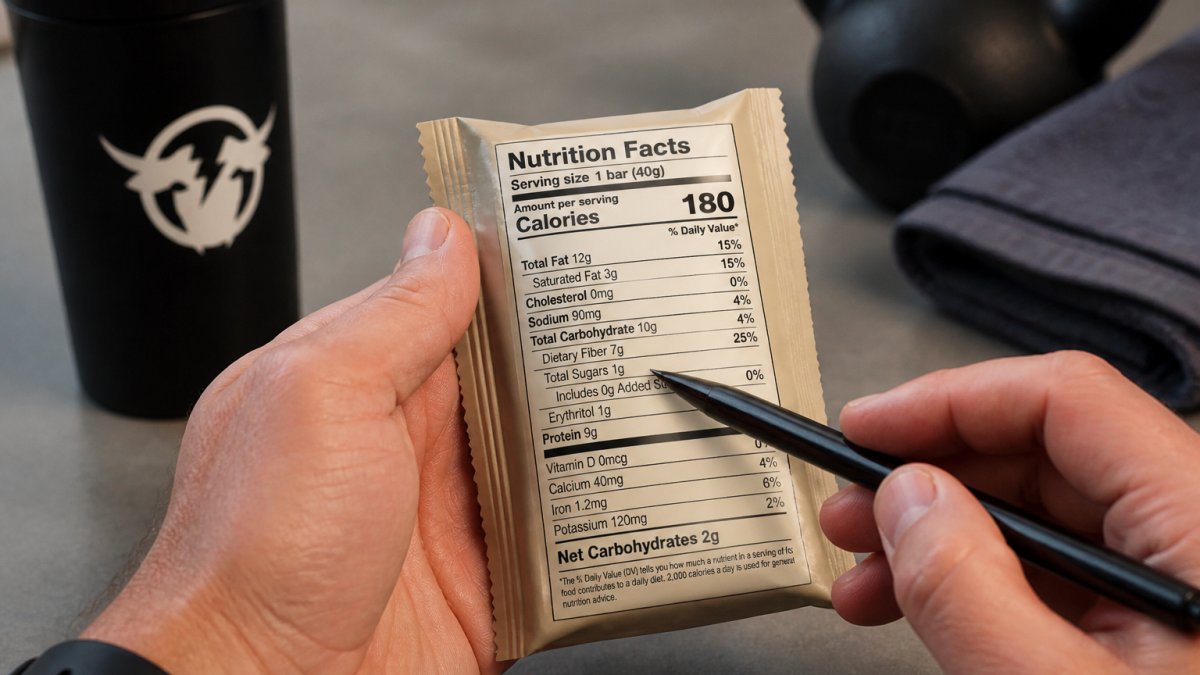
Step 1: Check the Serving Size First
Before you look at any numbers, find the serving size. This is where most people get tricked.
A snack bar might show 2 grams of sugar per serving. Sounds great. But if one serving is half the bar and you eat the whole thing, you've consumed 4 grams of sugar. Manufacturers intentionally use small serving sizes to make the numbers look better.
Always ask: Is this serving size realistic? Would you actually eat just half this snack? If not, multiply all the numbers by however many servings you'd actually consume.
Step 2: Locate Total Sugars and Added Sugars
The FDA requires food labels to show both total sugars and added sugars. For keto, total sugars is what matters.
Total sugars includes:
- Sugars naturally in the food
- Sugars added during manufacturing
Added sugars is a subset, just the sugars manufacturers put in. Some snacks have naturally occurring sugars (like from nuts or dairy). Others have added sugars. You need to account for both.
On a keto diet, aim for zero grams of total sugar per snack. This is the safest approach. Some people tolerate small amounts, but zero eliminates guesswork.
Step 3: Calculate Net Carbohydrates
Net carbohydrates is total carbohydrates minus fiber. This is the number that actually affects your blood glucose and ketosis.
The formula: Total Carbohydrates - Dietary Fiber = Net Carbs
Example: A snack has 12 grams of total carbs and 8 grams of fiber. Net carbs = 12 - 8 = 4 grams.
For keto snacks, most people aim for 3-5 grams of net carbs or less per serving. Some stay stricter at 2 grams or less.
But here's the catch: the label doesn't always show you everything you need to calculate net carbs correctly, especially when sugar alcohols are involved. That's the next section.
Sugar Alcohols in Keto Snacks: What Actually Counts
Sugar alcohols are the most confusing part of label reading for keto dieters. Some sugar alcohols barely affect blood glucose. Others spike it almost as much as regular sugar. The label won't tell you which is which.
Which Sugar Alcohols to Watch For
Not all sugar alcohols are created equal. Some are keto-friendly. Others aren't.
Minimal impact on blood glucose (keto-friendly):
Carnivore Electrolytes Beef Jerky Sticks →
- Erythritol
- Xylitol (in small amounts)
Moderate impact (use cautiously):
- Maltitol
- Sorbitol
- Isomalt
High impact (avoid on keto):
- Mannitol
- Lactitol
Maltitol is the worst offender. It's cheap, tastes good, and manufacturers use it constantly in "sugar-free" snacks. Yet it raises blood glucose almost as much as regular sugar. Many people find it kicks them out of ketosis.
Erythritol is the best option for keto. It has almost zero impact on blood glucose and doesn't cause digestive issues for most people. If a snack is sweetened with erythritol, you're in safer territory.
How to Calculate Net Carbs with Sugar Alcohols
The standard formula for net carbs doesn't account for sugar alcohols accurately. You need a better method.
For most sugar alcohols, subtract half the grams from your carb count:
Net Carbs = Total Carbs - Fiber - (Sugar Alcohols ÷ 2)
Example: A snack has 10 grams of total carbs, 4 grams of fiber, and 8 grams of maltitol.
Net Carbs = 10 - 4 - (8 ÷ 2) = 10 - 4 - 4 = 2 grams net carbs
For erythritol specifically, subtract nearly all of it since it has minimal metabolic impact:
Net Carbs = Total Carbs - Fiber - Erythritol
This is why knowing which sweetener was used matters so much. The same snack sweetened with erythritol versus maltitol can have vastly different effects on your ketosis.
Hidden Sugars in Beef Jerky and Meat Snacks
Beef jerky seems like the perfect keto snack. It's protein, it's portable, it requires no preparation. But many brands add hidden sugars during processing.
Manufacturers add sugar (or its aliases) for several reasons: it improves flavor, it helps preserve the meat, and it makes the jerky stick together during packaging. What it doesn't do is support your keto diet.
Common hidden sugars in beef jerky:
- Brown sugar (listed as "brown sugar" or hidden in "spice blend")
- Dextrose (in the curing process)
- Soy sauce (contains sugar)
- Teriyaki seasoning (loaded with sugar)
- Worcestershire sauce (contains sugar)
Grass-fed beef jerky with just salt, beef, and bone broth (like Carnivore Solutions Inc's offering) eliminates this problem entirely. Three ingredients. Zero hidden carbohydrates. That's the standard you should demand.
When shopping for jerky, read the ingredient list first. If you see more than five ingredients or any ingredient names you don't recognize, keep looking. The simpler the ingredient list, the safer the snack.
Common Label Tricks That Hide Sugar Content
Manufacturers use specific tactics to make sugary snacks appear keto-friendly. Knowing these tricks prevents you from falling for them.
Trick 1: Tiny serving sizes. A snack bar might be 40 grams, but the serving size is 20 grams. The nutrition facts show impressive numbers.
Trick 2: "No sugar added" claims. This doesn't mean sugar-free.
Trick 4: Vague ingredient descriptions. "Natural flavors" and "spice blend" can hide sugar. You don't know what's actually in there.
Trick 5: Changing formulations. A snack you've trusted for months might get reformulated with cheaper ingredients. The label changes slightly. Sugar content increases.
Check labels every time you buy, even if you've purchased the product before. Manufacturers reformulate constantly to cut costs.
Your Keto Snack Label-Reading Checklist
Use this checklist every time you evaluate a new snack:
| Step | Action | Red Flags |
|---|---|---|
| 1 | Check serving size | Size is unrealistically small |
| 2 | Read ingredient list | Unrecognizable names; more than 5 ingredients |
| 3 | Scan for -ose endings | Maltose, dextrose, fructose present |
| 4 | Look for syrups | Brown rice, agave, honey, molasses listed |
| 5 | Check starches | Modified food starch, tapioca, corn starch |
| 6 | Review total sugars | More than 0-1 gram |
| 7 | Identify sweeteners | Maltitol or unknown sugar alcohols |
| 8 | Calculate net carbs | More than 5 grams per serving |
| 9 | Verify nutrition facts | Numbers don't match ingredient list complexity |
| 10 | Trust your gut | Something feels off; skip it |
Quick reference for what to accept:
- Total sugars: 0-1 gram maximum
- Net carbs: 2-5 grams maximum
- Ingredient count: 5 or fewer
- Recognizable ingredients: You should know what every ingredient is
If a snack fails any of these checks, it's not worth the risk to your ketosis.
Most keto snacks on the market aren't designed for your success, they're designed for profit margins. Manufacturers hide sugars under confusing names, use tiny serving sizes, and make misleading claims because it sells more products.
The simplest solution is to choose snacks with transparent ingredient lists. Carnivore Solutions Inc's beef jerky sticks contain exactly three ingredients: grass-fed beef, bone broth, and sea salt. No hidden sugars. No decoding required. No surprises when you check your ketone levels.
Ready to upgrade your snack game? Shop our grass-fed beef jerky sticks and eliminate the label-reading stress entirely.
Frequently Asked Questions
Can a keto snack say sugar-free but still contain hidden sugars?
Yes. The FDA allows products to claim 'sugar-free' if they contain less than 0.5 grams of sugar per serving, but that doesn't mean zero carbohydrates. A snack can be labeled sugar-free while containing sugar alcohols, maltodextrin, or dextrose that still impact blood sugar and ketosis. Always check the nutrition label for total carbohydrates and the ingredient list for hidden sugar names, not just the front-of-package claim.
How do you identify hidden sugars in beef jerky?
Scan the ingredient list for brown rice syrup, honey, agave nectar, or syrups listed in the first five ingredients. Check the nutrition label for total sugars and total carbohydrates per serving. Many commercial beef jerky products contain 3-5 grams of sugar per ounce. Clean keto-friendly beef jerky should list only beef, bone broth, and sea salt with zero added sugars. Compare labels across brands; some hide sugars in 'flavoring' or use sweetener blends that spike carbs.
What's the difference between total carbs, fiber, and net carbs?
Total carbohydrates include all carbs in a serving. Fiber is a carbohydrate your body doesn't fully digest. Net carbs are calculated as: total carbohydrates minus fiber (and sometimes minus sugar alcohols). For keto, net carbs matter most because they affect blood sugar and ketosis. When reading a keto snack label, subtract fiber and erythritol or xylitol from total carbs to find net carbs. This is why a snack can claim low net carbs while showing higher total carbohydrates.
Which ingredient names indicate added sugar in keto snacks?
Look for maltodextrin, dextrose, maltose, fructose, sucrose, glucose, brown rice syrup, agave nectar, honey, maple syrup, corn syrup, and modified food starch. Ingredients ending in -ose are almost always sugar or sugar-derived. Also check for 'natural flavors' combined with sweeteners, as these can hide sugar content. The ingredient list order matters: if sugar appears in the first three ingredients, the snack is high in carbs regardless of the front-of-package label.